
The Story of Maria Montessori
One of the first Italian women to be a doctor, education pioneer, defied Mussolini.
Chiaravalle, 1870 the beginning
Maria Montessori was, as the kids would say today, based. This is not an insight, but a fact, and in the next few pages I'm going to summarize her wild story both in an effort to learn it better myself, and amplify it to the world.
One day, in August of 1870, a girl was born in Chiaravalle, Italy. Little did her family know she would change the world. Her dad worked at the Ministry of Finance and was described as "An Old-Fashioned Gentleman" by one biographer. Her childhood wasn't that extraordinary — her family moved with her father where he worked, she went to different schools, even got a needlework certificate at one of them, foreshadowing a later interest perhaps.
The only thing remarkable was that she continued pursuing her schooling, her education, like her mother, who was remarkably well educated.
Getting into medical school 1890 – 1896
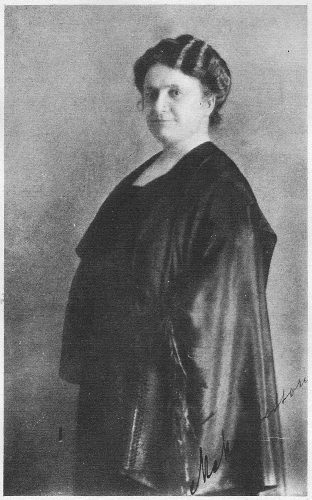
First she went to the University of Rome for Natural Sciences before then wanting to pursue medical school there. Only, women didn't go to medical school, but Maria was, as we know, stubborn, so she tried anyway. She went to the professors and asked to be let in — her scores and aptitude were good enough, she told them — but they bid her buongiorno, saying women do not go to medical school, Maria. Realizing that they would not open their minds that way, she tried a different tack: religion.
She approached the pope and asked him to give her an exception so she might have a chance to study what she wished at school. Surprisingly, he was down to ride, and she came back to the school with a custom letter giving her permission. With that she began, and despite ridicule from the men around her, balled tf out. But there was another problem. It was considered improper for her to poke dead bodies around men, so she found a way to do her labs alone with candlelight at night, stitching and dissecting alone.
Grudgingly many men came around to realizing how qualified she was, but there was a big final test: a presentation. Men in the town prepared to go laugh at her. They told her friends, and her father, who she was not speaking to. She was nervous, but prepared thoroughly.
When she gave the speech, she was so impassioned, so clear, so eloquent that the men who came to laugh gave her a standing ovation, her father rekindled their relationship, and she was praised as qualified.
The asylum, and the crumbs what nobody else saw
From there she began working at an insane asylum. Kids, adults, women and men — she watched and studied them. Often at meal times she would notice the kids diving off their seats to scratch around at, seemingly, the ground. Her colleagues laughed and put down the kids, demeaning them for what they thought was gross behavior. What they didn't realize was what Maria found when looking closer.
When she looked into the details of the kids' actions she realized they weren't scratching at the ground at all, but playing with crumbs of food on the ground as if they were toys. The kids didn't have any other materials, so they used what fell to the ground at meal time.
This insight only further interested her in the kids at the asylum, and she began working with them even more closely.
The school for the insane Itard & Séguin
As time passed, so came an opportunity to work at an orthophrenic, a "school for the insane". Again, she showed out. As the greats do, she searched for experts in this field, and found two knowledgeable men. One named Jean-Marc-Gaspard Itard and another named Édouard Séguin. Itard was notable because he had worked with a boy considered "the wild boy", who had lived in the forest alone until he was found as a child. Having done so, he hadn't gone through normal socialization and had a hard time communicating, let alone learning and fitting in. In Itard's process working with him to communicate and learn, Itard created different learning tools, techniques and materials that Maria found very compelling.
Maria then applied Itard's strategies to the kids at her school for the insane, producing notable results. Maria went on to say that her time at the school was her "only real and true degree in pedagogy". This learning of learning models served her and the kids well, with some of them getting results on state standardized tests and her getting some renown.
San Lorenzo 6 January 1907
In another part of Rome was a district named San Lorenzo, and it was considered an embarrassment to Italy. There were apartment complexes with 3-4 families per apartment, privacy was poor, hygiene was poor, social unrest was high — it was a bad place to live.
In an attempt to remediate it they even renovated the apartments, with the agreement that the families would take good care of them, but the problem became that the kids left alone at home while the parents were working caused damage over and over again.
So they proposed a fix: a school or childcare center where these very young kids would go while the adults left during the day, and Maria was recruited. However, Maria had never designed a school before, let alone one with more normal kids. She had work to do.
So she did her science thing and went and observed the kids and their lives. They were around violence and drugs, prostitution and temptation. As she said, "They had no casa." No home. So she created one. She got first-of-its-kind custom furniture for kids, she brought special learning materials based on Itard's learnings, and designed a place where the kids could come be safely. It opened on 6 January 1907.
She took copious observation notes and constantly looked to improve and understand education through the kids' natural tendencies. She got rid of toys they didn't use and even, after leaving a cupboard unlocked one night and finding the kids playing independently the next morning, gave the kids more and more opportunities and freedom of choice.
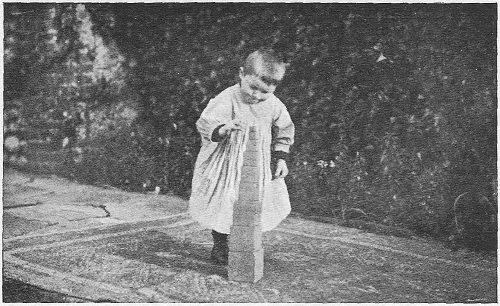
There were some special lessons she learned. Things like kids are competent enough to have freedom of choice, and that they are capable of intense long concentration, that they like to work and take it seriously, and that they like to practice and repeat things they are shown how to do, and surprisingly, they have learning explosions where they make realizations of ability and practice repeatedly.
The learning explosions writing, then reading
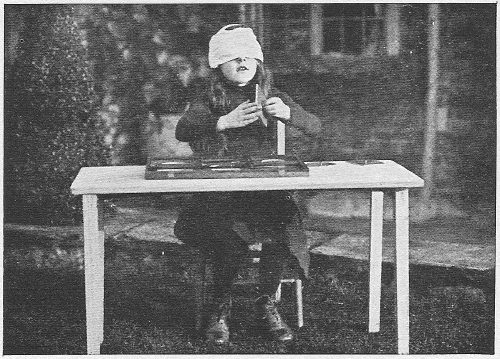
These learning explosions went like this: Miss Montessori, teacher! Let us learn how to write! Despite the societal belief that kids couldn't learn before 6, she let them, by giving them blocks with letters on them and independent lessons to do. Soon they were writing, but then she had an idea that changed everything. She decided to see if they knew how to read, so she wrote on a blackboard "If you can read this come give me a kiss".
A day passed, then two days, but on the third day a girl came up and said "Miss Maria, I am here to give you a kiss". Spontaneously she had decided she could read, by sounding out the letters.
India, the Netherlands, and peace 1939 – 1952
She found a home in the Netherlands and continued working on her organization AMI, founded in 1929, to guard and carry-on her vision into the future. She also spent time rebuilding schools across Europe and speaking to spread the knowledge and excitement about her Montessori Method. Her big mission during these years was guiding the future towards peace after having lived through two world wars. This was based on her belief that education was the best way to prevent war in the future.
She was also nominated for the Nobel Peace Prize in three separate years — 1949, 1950 and 1951 — six nominations in all. She died at Noordwijk aan Zee in the Netherlands on 6 May 1952, aged 81.
The method now ~0.25 SD
Now, her Montessori method, characterized by mixed age classrooms, "auto-learning" (kids directing their own learning) and teachers as guides rather than specific subject matter experts, is used around the world and shows to help kids do about a quarter of a standard deviation above average.